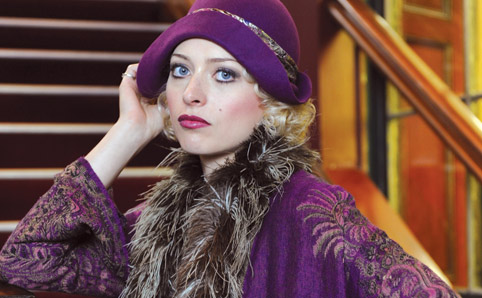
Meryl Streep's magnificent Maggie Thatcher well and truly matches Helen Mirren's remarkable Queen. It helps, of course, that the script is so well written by Abi Morgan, but to humanise this incredible woman is a great achievement, whoever you give the credit to.
Of course, it is only her most obvious frailty that provides the window of opportunity. Morgan's script capitalises on the ageing Thatcher's senility, and I don't think there is any other way really to bring the woman down to earth enough for an audience to relate to her as a character.
The film lacks some of The Queen's zing. It creates magnificent character, but because of its broad sweep, it fails to create such a clear focus and the character is only just enough to cover the rather flat narrative structure.
The Iron Lady is a very good film, and one well worth watching. But just in case any of you Poms were thinking about it, I've now seen enough biographical films about your twentieth century politicians. They're really not that interesting.
"It is not the critic who counts. Not the man who points out how the strong man stumbled or where the doer of deeds could have done better. The credit belongs to the man who is actually in the arena, whose face is marred by dust and sweat and blood; who strives valiantly; who errs and comes short again and again; who knows the great enthusiasms, the great devotions; who spends himself in a worthy cause."
-Theodore Roosevelt
14 February 2012
28 January 2012
The Adventures of Tintin
Late though I might have been, I finally managed to take the kids along to see The Adventures of Tintin. They weren't that interested at first, and I can understand why, since the marketing is targeted at a higher age group and is certainly intended to attract adults. And by the time we went, it was no longer showing at Limelight, and we had to settle for Hoyts.
I don't know why I particularly wanted to see this movie, as I never read the comics or had any experience of it before, but the trailer had me enthralled, and I was really keen. Obviously, the usual problem with films that you're really eager to see is that they fail to live up to expectations. Not the case with Tintin.
The characters are really engaging, especially the bumbling detectives who are simply the most hilarious of characters. Tintin himself is endearing in a very personable way, since he is admired by all the characters for his prowess, but is nonetheless genuinely concerned with other people's welfare. He is, at the same time, subject to frustrations and these shine through with pristine dialogue and amazing animation.
I'm not normally a fan of animation that looks too realistic, I'd usually prefer cartoons to look like cartoons, but in this context it just works.
The Adventures of Tintin is barely a children's movie; there is a fairly long-running theme of violence, but it is handled well, and though my daughters (age 10 and 7) tensed up a lot, I never felt uncomfortable with the level of violence they were seeing.
This is a great film, especially for its characters, but also for its excellent animation.
I don't know why I particularly wanted to see this movie, as I never read the comics or had any experience of it before, but the trailer had me enthralled, and I was really keen. Obviously, the usual problem with films that you're really eager to see is that they fail to live up to expectations. Not the case with Tintin.
The characters are really engaging, especially the bumbling detectives who are simply the most hilarious of characters. Tintin himself is endearing in a very personable way, since he is admired by all the characters for his prowess, but is nonetheless genuinely concerned with other people's welfare. He is, at the same time, subject to frustrations and these shine through with pristine dialogue and amazing animation.
I'm not normally a fan of animation that looks too realistic, I'd usually prefer cartoons to look like cartoons, but in this context it just works.
The Adventures of Tintin is barely a children's movie; there is a fairly long-running theme of violence, but it is handled well, and though my daughters (age 10 and 7) tensed up a lot, I never felt uncomfortable with the level of violence they were seeing.
This is a great film, especially for its characters, but also for its excellent animation.
06 November 2011
Underbelly Razor
![]() |
| Chelsea Preston-Cormack as Tilley Divine |
The clever use of music from recent decades covered as jazz numbers from the nineteen twenties is a touch of genius. It stamps the series as modern (just in case you're not watching it in HD), and draws the audience into the period with much-needed humour. The dialogue only occasionally diverted from the vocabulary of Australian English in the period, and the settings for the action of the series are impeccably depicted. Few films manage such superb historical aesthetics, but it is especially remarkable for a television series.
The series' two protagonists, Kate Leigh and Tilley Devine, are played by Danielle Cormack and Chelsie Preston-Crayford respectively, and their performances have been thoroughly engaging. While Danielle Cormack is a familiar and welcome face on our screens, I've never seen Preston-Crayford, and she is equally noteworthy. She also gained my attention because she's playing the namesake of one of Canberra's best-known cafes, and this explains a lot for those of us who live in the capital!
![]() |
| Danielle Cormack as Kate Leigh |
Underbelly Razor is, of course, not without its historical faults, though most are negligible. The one notable problem is the way the police are depicted. The senior ranks of the New South Welsh police seem genuinely concerned with law and order, which seems to be at loggerheads with the histories I've read covering law and order in Sydney in this period. The police were as actively involved in the underworld as Tilley Devine and Kate Leigh, and to depict them as antagonists is taking a lot of dramatic licence! The inherent and utter corruption of the New South Welsh Police Force is known to have been a key factor in the development of the Sydney underworld from the early nineteenth century until the end of the twentieth, and this series treats police corruption merely as a minor theme.
I will accept this as dramatic licence, as the research required to depict the rest of this world must have been substantial, and I can't see how the writers could have been entirely ignorant of the key role the police played in the Sydney underworld. And forgiving them this licence leaves possibly the best television series I've ever seen; and I love television! Underbelly Razor has the production qualities of our best films, with excellent performances, great dialogue and a great story, well told.
Now I want to see the earlier seasons!
04 November 2011
Lapland Odyssey
Introducing his film at the Canberra International Film Festival, director Dome Karukoski talked about the Finnish cultural cringe, and my first thought was that this would relate well in Australia, where our national identity is also commonly defined by our deficits. Lapland Odyssey is a hilarious romp through a landscape that's about as foreign to Australia as it is possible to get, but its characters and humour will be as familiar to audiences of Australian films as sunshine and barbecues.
Karukoski is suitably cynical of the saleability of a comedy that starts with five suicides, but this black opening sets the tone perfectly for the hapless Janne. In his all-night search for the digibox he needs to secure his marriage, Janne leads his two hapless friends into Finnish Lapland wilderness amongst blizzard conditions, Russian tourists, the Aurora Borealis, animatronic deer and not a few boobs.
If I have to watch a formula film, the road movie is always my favourite. The formula, at its best, lends itself to a strong and consistent plot arc, excellent characterisation and endless laughs. Lapland Odyssey has all these features and is a model of the genre.
It puts me in mind especially of what I think is one of Australia's best comedies: Lucky Miles. Also a road movie, it is set in our most extreme landscape and finds humour in the imperfections of our national character. Lapland Odyssey does much the same in a Finnish context, and is also funny as hell!
You may have missed your chance to see this as part of the 2011 Canberra International Film Festival; for a taste, the trailer is here.
Karukoski is suitably cynical of the saleability of a comedy that starts with five suicides, but this black opening sets the tone perfectly for the hapless Janne. In his all-night search for the digibox he needs to secure his marriage, Janne leads his two hapless friends into Finnish Lapland wilderness amongst blizzard conditions, Russian tourists, the Aurora Borealis, animatronic deer and not a few boobs.
If I have to watch a formula film, the road movie is always my favourite. The formula, at its best, lends itself to a strong and consistent plot arc, excellent characterisation and endless laughs. Lapland Odyssey has all these features and is a model of the genre.
It puts me in mind especially of what I think is one of Australia's best comedies: Lucky Miles. Also a road movie, it is set in our most extreme landscape and finds humour in the imperfections of our national character. Lapland Odyssey does much the same in a Finnish context, and is also funny as hell!
You may have missed your chance to see this as part of the 2011 Canberra International Film Festival; for a taste, the trailer is here.
30 October 2011
King of Devil's Island
The violence of power and the power of violence are both explored beautifully in King of Devil’s Island. A true story, based on events occurring in 1915 at Bastøy Island in the Fjord of Oslo; a detention centre for ‘maladjusted boys’, as the subtitles tell us.
Maladjusted is somewhat ironic in the context of this story. The boys in the film are remarkably well-adjusted, and have as keen a sense of right and wrong as their ‘protectors’. Each of the film’s protagonists fail at some point to act according to their convictions, as do their protectors, who subtly develop into the story’s antagonists.
What I like most about this film is that although it casts certain historical figures clearly in the role of antagonists, all of them are fully developed, and all but one are depicted with a degree of empathy. Just like the protagonists, they’re pawns in a bloody game of chess being played by rulers as remote and inviolate as kings. Violence, in this context, is the inevitable response.
I can hardly put into words how much I like this film. Beautifully shot in the fjords, with precise timing matching the mood of the film to the development of the winter and remarkable performances from a very talented cast. This film is perfect.
You may have missed your chance to see this as part of the 2011 Canberra International Film Festival; for a taste, the trailer is here.
Maladjusted is somewhat ironic in the context of this story. The boys in the film are remarkably well-adjusted, and have as keen a sense of right and wrong as their ‘protectors’. Each of the film’s protagonists fail at some point to act according to their convictions, as do their protectors, who subtly develop into the story’s antagonists.
What I like most about this film is that although it casts certain historical figures clearly in the role of antagonists, all of them are fully developed, and all but one are depicted with a degree of empathy. Just like the protagonists, they’re pawns in a bloody game of chess being played by rulers as remote and inviolate as kings. Violence, in this context, is the inevitable response.
I can hardly put into words how much I like this film. Beautifully shot in the fjords, with precise timing matching the mood of the film to the development of the winter and remarkable performances from a very talented cast. This film is perfect.
You may have missed your chance to see this as part of the 2011 Canberra International Film Festival; for a taste, the trailer is here.
Subscribe to:
Posts (Atom)